









Life Habits Framework
TIER I
- Tier 1 Interventions – Behavior Intervention - add blurb
- Teaching Behavior Expectations - add blurb
- Morning Meetings - a welcoming inclusion activity, routine, or ritual that builds community and connects to the work ahead.
- Why Morning Meetings?
- Morning Meeting Slides Slides (sent to Justin to create LL version by 5/4)
- Life Habits Mini-Lessons - classwide mini-lessons that can guide collaborative conversations on the skills of self-awareness, self-management, and social awareness.
- Life Habits Family Bingo - a school-wide activity that students can practice building the habits of self-awareness, self-management, and social awareness with their family.
- Life Habits Family Engagement Bingo Template: - (one per 9 weeks? Monthly? Pull ideas from my calendars? Or specific strategies the campus is practicing at school?)*develop an example in Canva to insert here
- Life Habit Monthly Family Engagement Videos - insert blurb from newsletter
- Life Habits Family Calendar - a monthly calendar with small actionable daily habits that connect to the monthly family engagement videos which will build self-awareness, self-management, and social awareness skills.
- CHAMPS Refresher - a behavior management system that establishes clear classroom behavior expectations to reduce misbehavior.
- Social Class Contract - is an agreement between teacher and students about the values, rules, and consequences for classroom behavior. Its purpose is to establish rules and consequences based on guiding principles or values that will guide students in their activities and interactions together. It can be used to reference back to throughout the day as a teaching moment and to keep each other accountable for our dispositions.
- Common Language - common phrases used throughout the campus to respond to students and staff.
- PBIS Visuals - visual reminders of expectations in classrooms and throughout the campus.
- Common Area Expectations - clear campus-wide expectations that are taught, practiced, and reinforced consistently in areas such as lunchroom, auditorium, restrooms, hallway, playgrounds, and drop-off/pick-up areas. All staff should be aware of and have the same student expectations for common areas.
- Shout Outs - positive, public recognition for students going above and beyond to demonstrate Life Leader Attributes.
- Positive Reinforcement - a desirable or pleasant consequence applied after a behavior making the behavior more likely to reoccur.
- Teach, Model, Practice - a method for introducing expectations; teach the expectation, model the expectation, and practice the expectation frequently.
- Lifesavers - reflection questions, resources, and actionable steps that are aligned to the Life Leader Attributes of Information Literacy and Problem Solver.
- Whole Brain Strategies - an educator quick sheet on 10 low burden, high impact strategies to practice de-escalation with students. Professional Development - training throughout the year that is specific to implementing, maintaining, and reinforcing PBIS. This includes campus PD, district PD, and PLC training.
- The Good Behavior Game - is an evidence-based behavioral classroom management strategy that helps children learn how to work together to create a positive learning environment.
- Mystery Motivator Reward - This compelling behavioral reward system delivers a special mystery reward for desired behaviors.
- Attention Signal - This classroom management tool is a signal that teachers use to obtain students’ attention.
- Tell Me Something Good -
- Affirmations - Classroom affirmations are used to create a positive and supportive environment by teaching students to be supportive of one another.
- Non-Verbal Signals - Teachers can also use non-verbal signals to reply to student requests and to emphasize actions that students need to perform.
- Table Points - This class wide motivation system requires students to collaborate in groups and allows them to earn rewards for their positive behaviors.
- Student Leaders - Assigning Student Leaders in the classroom fosters ownership, community, and cohesiveness among class members.
- Designated Calming Space - an area in a classroom where students can take time (on their own) to self-regulate their emotions.
- Proactive Intervention Toolkit - basic practices that are key for every classroom management plan.
- Have student say a nice thing to the student they called a name
- Mindfulness Practices -
- Self-Managed Responses - strategies to respond to in instances of misbehavior
- Positive Phone Calls Home (Link Script) - phone calls made to parents to recognize students demonstrating the Life Leader Attributes.
TIER II
- Tier 2 Interventions – Behavior Intervention
- Collecting Data - information gathered & documented over a set period of time including behavior, date, time, duration, what happened before the behavior, and what happened after the behavior.
- Weekly Conferencing - a one-on-one meeting for the teacher to meet with the student to foster relationship building, student voice in developing goal, and reflect on progress towards goal.
- Token System - a token economy is a system of contingency management based on the systematic reinforcement of target behavior. The reinforcers are symbols or tokens that can be exchanged for other reinforcers.
- Counselor Support with Small Group - small group meetings between the counselor with 3-4 students that foster relationship building and building capacity for social-emotional learning, and self-regulation tools.
- Check & Connect - daily check-ins between a staff member and a student to foster personalized relationship building.
- Student Jobs - routine tasks a student can complete (unrelated to academics) to build a sense of belonging and self-worth.
- Behavior Contracts - an agreement between the student and staff member to help support the student’s plan.
- Targeted Instruction in Self-Regulation & Social Skills - additional instruction on key social, emotional, and/or behavioral skills.
- Pre-Corrections - A key practice to prevent problem behaviors is to anticipate when a student is likely to act out and do something to get ahead of it.
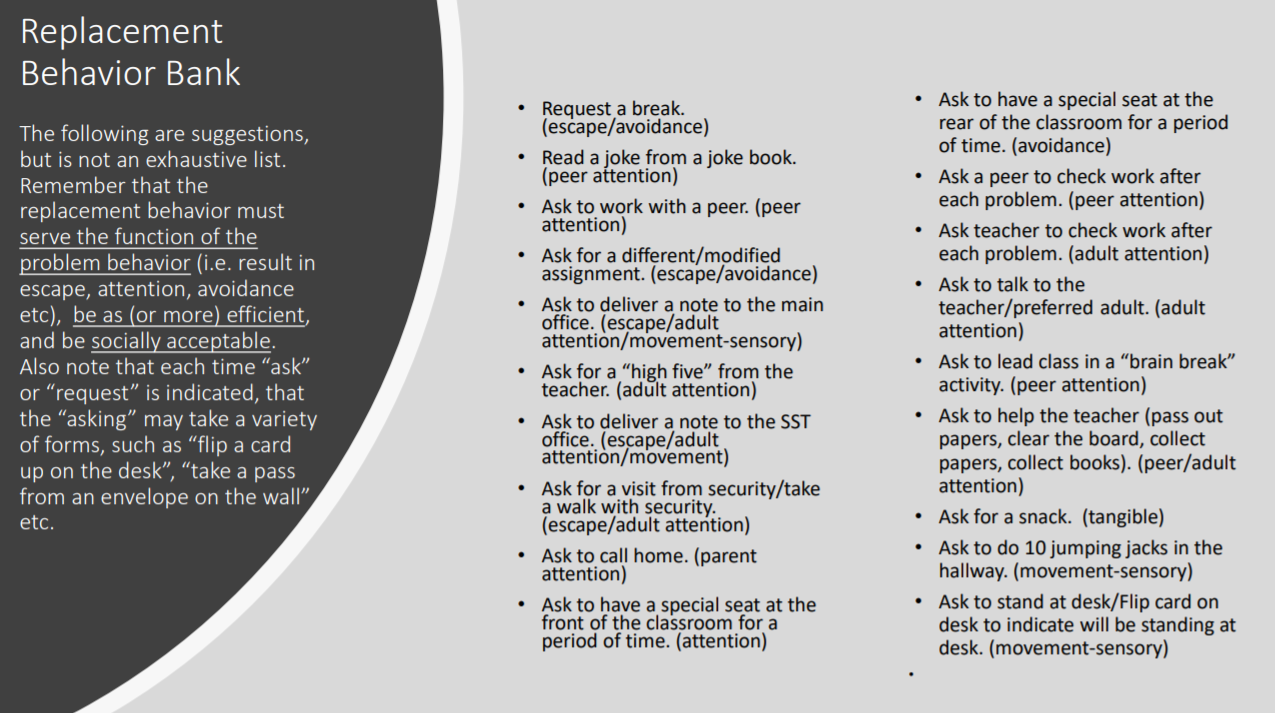
- Functions of Behavior - Discover what motivates students to behave a certain way, teachers can help them find alternatives to their unwanted behavior.
- Behavior Functions Examples
- Lifesavers Action Steps
TIER III
- Tier 3 Interventions – Behavior Intervention
- Plan Created - a plan to implement an intense intervention based on behavior data and goal.
- Team Approach - All Stakeholders “on deck” to help implement a plan to support the student.
- Data Collection - information gathered & documented over a set period of time including behavior, date, time, duration, what happened before the behavior, and what happened after the behavior.
- Behavior Contracts - an agreement between the student and staff member to help support the student’s plan.
- Behavior Coach Support - request for support from the district Life Habits Coach will come from campus administration.
- Functions of Behavior - a guide to help staff members understand why behaviors are happening and what we can do to help.
- Teaching Appropriate Behavior - identifying the specific misbehavior and teaching, model, and practice of replacement behavior.
- Strengths Identification - using a strengths-based approach to assist the student (Gallup).
- Parental Support - collaborating with parents/guardians to support the student.

Teacher Incentive Allotment

87 of 100 (B Rating)
Texas Education Agency

Gold Medalist
Dallas Morning News Peoples' Choice

Superior
Texas Charter First Financial Accountability